 |  | Education -> Intellectual property theft |  |

 | |
| | This section covers intellectual property and trade secret theft in the news. Intellectual property and trade secret theft increases every year. Yet what are companies doing to protect their IP and do they know where it is going? Many companies think they have satisfactory measures in place for protecting their intellectual property through data access. These may be in the form of passwords, biometrics, file encryption, non-disclosure agreements, firewalls, anti-virus, intrusion prevention and employee training. The reality is however is that most companies have no idea where their intellectual property is really going.
INTELLECTUAL PROPERTY THEFT 2007 One-third of US enterprises admitted losing sensitive data One-third of US enterprises recently surveyed admitted losing sensitive data in the past 12 months, while another 11 per cent were 'unsure' whether a breach had occurred. Research conducted by the Enterprise Strategy Group for information monitoring firm Reconnex noted that intellectual property protection goes beyond securing private records. Fear of intellectual property theft has become such a priority that 90 per cent of companies plan to deploy new technologies to secure their information in the next 12 months. Vnunet 2007.
Draft directive on the criminalization of IP infringement across Europe A key committee in the European Parliament has endorsed a draft directive aimed at harmonizing rules on the criminalization of IP infringement across Europe. The Legal Affairs Committee last week voted to introduce fines of at least €300,000 and four years' imprisonment in serious cases of breaches of IP rights and €100,000 in minor cases. The Committee also backed a plan to set up so-called Joint Investigation Teams that would allow IP owners to take part in the investigations, alongside the police. March 26, 2007.
US Senators propose bill to cut IP theft Two US senators have introduced draft legislation designed to help IP owners enforce their rights. It has been reviewed twice by the Senate and has now been referred to the Judiciary Committee. Democrat Senator Evan Bayh and Republican Senator George Voinovich introduced the Intellectual Property Rights Enforcement Act in the Senate on February 7. The bill sets out to improve the management, coordination and effectiveness of domestic and international IP enforcement. The bill's sponsors say that the World Customs Organization (WCO) estimates that up to 7% of global trade is in counterfeit goods. Additionally, the WCO estimates that the global trade in counterfeit and pirated goods has increased from $5.5 billion to $6 billion.
Theft of information and regulatory compliance are number 1 security concern Theft of information and regulatory compliance are beginning to replace malware infestation and hacking as the top security concerns, according to a poll of enterprise IT security chiefs. The second annual Cisco-sponsored poll of 100 infosec pros in large UK enterprises found that 38 per cent of respondents place theft of information as their number one concern, while 33 per cent fret about regulatory compliance. Viruses, the prime concern of 55 per cent of respondents in 2006, were cited by just 27 per cent as their top fear this year. April 2007
UK business is loosing over £50 million a year to IP theft UK business is loosing over £50 million a year through fraudulent employee activity. Research by consultant Protiviti has revealed that more than 3 million workers (one in ten) have admitted to various forms of stealing from work, personneltoday.com reports. Women fared better than men, with 9 per cent defrauding their employers compared to 15 per cent of male workers. London was particularly bad for corporate crime, with one in five employees in the capital admitting to theft of some kind.
INTELLECTUAL PROPERTY THEFT 2006 Heady bill for intellectual property theft in 69 countries An estimated 760 copyright and trademark intellectual property thefts in 69 countries between January and June 2006 cost companies nearly $700 million, up 7 percent from the year-ago period, according to Gieschen Consultancy's 2006 Mid-Year Counterfeit & Piracy Intelligence Report. The United States is top of the list, citing 205 violations and $51.7 million in losses. The United Kingdom ranked second, with 116 reported violations costing $31.1 million. Next is India, with 87 incidents at $2.5 million; Malaysia, 52 incidents costing $5.9 million; and China, 43 incidents at $5.3 million. Information Week 2006.
Use of DRM to protect intellectual property can no longer be ignored "In spite of the stigma attached to DRM (mainly by the spectrum of users that prefer the free flow of information), its role to secure information against theft or losses cannot be ignored. The world DRM market has been struggling for over a decade to establish itself as a legitimate market and its time has finally come. The need to protect corporate information or copyrighted works has become a pressing concern with a real monetary value attached to it. Corporations are beginning to understand the impact of information loss and the havoc it can do to revenue streams. The entertainment industry is in an ongoing battle against pirates and has begun to embrace DRM and started evangelizing its value to the consumer market. This has helped paved the way to greater acceptance of this technology in the consumer market." Quote from Frost & Sullivan, May 2006.
Economic espionage - the number one threat to the US Economic espionage is as real a threat as terrorism or global warming. But it is subtle, insidious and stealthy. Even if the United States finds the will to come to grips with the many threats it faces, this silent, invisible hemorrhaging of intellectual know-how and trade secrets could deliver the death blow to our pre-eminent place in the global economic world before we even wake up to the magnitude of the danger. CIO Magazine 2006.
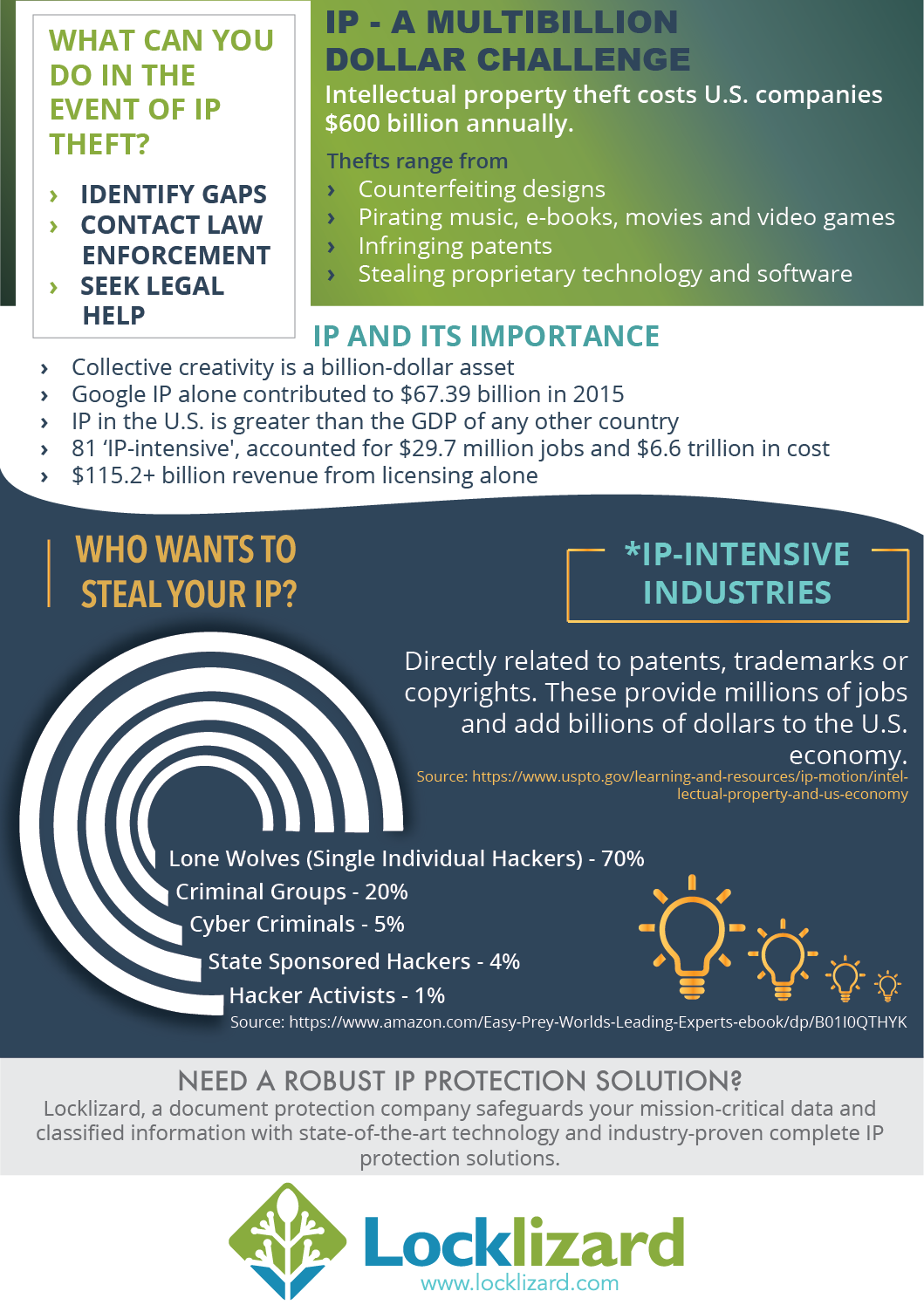
Intellectual property theft rising steadily According to the U.S. Commerce Department, intellectual property theft is estimated to top $250 billion annually (equivalent to the impact of another four Katrinas), and also costs the United States approximately 750,000 jobs, while the International Chamber of Commerce puts the global fiscal loss at more than $600 billion a year. But both estimates appear to be woefully underestimated; by some other estimates, there was over $251 billion worth of intellectual property lost or illegal property seized in August 2005 alone. CIO Magazine 2006.
Management attitudes to data theft are rather lax Research from Prefix IT shows that lax management attitudes have allowed a culture of data theft to flourish in the British workplace. A picture of poor processes, policy creation and communication shows that management practices are badly out of step with today’s office morals; 60 percent of workers admit to theft of confidential documents, customer databases, business contacts and sales leads. Data theft is endemic, yet only 7 percent of managers believe their companies have been affected by the issue and 29 percent of managers say the topic is not recognised at board level. This climbs to 50 percent in SMEs. Few employees are aware of security measures or company policies that prevent workplace theft and the majority of workers do not believe it is ‘wrong’ to steal from the office.
INTELLECTUAL PROPERTY THEFT 2005 The real cost of intellectual property theft Theft of intellectual property costs U.S. businesses around $250 billion annually, as well as 750,000 American jobs. Globally, trade in illegitimate goods is worth more than $600 billion a year. Information Week 2005.
The real cost of copyright piracy Schwartz said U.S. industry lost over $1.7 billion last year alone to copyright piracy in Russia, and over $6 billion in the last five years.
Threat of intellectual property theft is growing rapidly Over two-thirds of manufacturers fear the threat to their product intellectual property (IP) has grown over the past two years, new research has found. According to the poll conducted by Aberdeen Group, almost 25 per cent of respondents say the threat has jumped "significantly" - as they develop, manufacture, and sell products globally. These findings confirm 2005 Aberdeen benchmarks in which manufacturers reported protecting product IP as the top challenge of global design.
The new study, The Protecting Product Intellectual Property Benchmark Report: Safeguarding Design IP in a Global Market, explains how common approaches to global design and manufacturing - including using unsecured emails and documents - increase IP risk. "Among companies benchmarked, 48 per cent report lost market share, 44 per cent lost sales, 30 per cent product commoditisation, and 27 per cent lower margins because of compromised product IP," said Jim Brown, Aberdeen vice president, Product Innovation and Engineering, and report author. "In response, over two thirds are actively pursuing improved product IP protection, with almost one third viewing this as a top-five business priority. " Respondent companies that were identified as being best in class at protecting product IP were five times more likely to report significant gains in IP protection over the last two years than the poorest performers. These leaders have developed multi-faceted IP protection strategies that include IP-friendly collaboration, documenting IP discovery, legal protection, and enhanced data security.
Microsoft offer prize to raise awareness of intellectual property theft Microsoft is offering a prize of £2,000 for the best film that raises awareness of intellectual property theft. The film must carry the theme of "how intellectual property theft affects both individuals and society", and the winner will get £2,000 in vouchers for film equipment. Eight runners up will win a trip to London to see the films being screened. "The subject of intellectual property theft is often seen as legalistic and frankly a bit dull," said Alex Hilton, anti-piracy manager at Microsoft. "The truth is that intellectual property is really about people's creations. When someone has worked hard on a creation, it's unfair to see it stolen in front of their eyes."
INTELLECTUAL PROPERTY THEFT 2004 Intellectual property theft down to employees Most intellectual property (IP) theft is perpetrated by current and former employees. According to the U.S. Department of Justice, enterprises suffered $250 Billion in IP Theft in 2004.
69.6% of business professionals have stolen some form of corporate IP from their employer when leaving a job.
32.6% of employees leaving a job took sales proposals and/or presentations with them.
30.4% admitted to taking information such as customer databases and contact information. The most commonly used method for stealing IP is to send electronic copies of documents and files to a personal email account.
58.7% think that taking IP is as, if not more, acceptable as exaggerating an insurance claim to cover the excess charge.
Only 28.2% think that IP theft is completely unacceptable.
The most common justification for IP theft was that the person had created the documents/files stolen and felt they partly belonged to them.
Singapore Economist accused of intellectual property theft High Frequency Economics Limited (an independent financial research company) filed a lawsuit against HVB (Singapore economist) claiming that they had copied substantial portions from at least 22 of its high value research reports and had posted them on their web site claiming them as their own. Wall Street Journal 2004.
Intellectual property theft is rampant A survey of professional investigators and risk managers conducted by Deloitte Forensic, at the 2004 Asia Pacific Fraud Convention, has found that intellectual property theft is rampant. Intellectual property theft includes employees who have downloaded customer lists, copied software coding or stolen business plans and taken them to the competition. Respondents to the survey said that reputational damage was the most costly impact of corporate fraud, followed by revenue leakage. Deloitte Australia 2004.
Intellectual property held mainly on laptops Two thirds of valuable corporate data resides on laptops and nowhere else according to Gartner. Intellectual property theft fueled by loss of mobile devices Loss of mobile devices is in fact among the top three breaches in content security according to Jupiter Research. The other two are viruses that put content in unauthorized hands and unintended forwarding of e-mails, such as when an email client auto-populates the wrong address.
IT fuels intellectual property theft Technology makes it too easy for staff to steal corporate secrets, says survey. Intellectual property theft is costing UK businesses billions of pounds each year, and is getting worse because of the ease with which electronic documents and files can be stolen. Some 70 per cent of the 400 workers polled by computer forensics firm ibas confessed to stealing corporate secrets when they left their last job.
INTELLECTUAL PROPERTY THEFT 2003 $300 billion lost due to intellectual property theft Over 93% of the information produced in 2003 was in digital format and more than $300 billion was lost in 2003 due to Intellectual Property theft. Organizations lose $2.7 million in proprietary information 70% of organizations surveyed have deployed a combination of "fortress" security controls including file encryption, intrusion detection, firewalls, physical computer security, and access controls. These same companies reported an average loss of $2.7 million in proprietary information. CSI (Computer Security Institute) / FBI 2003.
Trade secret theft - design blueprints stolen A Chinese-American man was charged with stealing $10 million in IP (integrated circuit design blueprints) from Ali Corporation. Interfax China 2003. Trade secret theft of rocket program documents Two former Boeing managers were charged in a plot to steal trade secrets (documents concerning a multi-billion dollar rocket program for the US Air Force) from Lockheed Martin during a competitive bid. US Department of Justice, 2003.
INTELLECTUAL PROPERTY THEFT 2002 IP theft facts US companies alone lose between $53 and $59 billion a year in IP and proprietary information. PWC Survey 2002. INTELLECTUAL PROPERTY THEFT 2001 IP theft facts - corporate espionage Corporate espionage accounted for 39% of leaks in 2001. IP theft facts - internal sabotage Internal sabotage accounted for 25% of leaks in 2001. IP is as high as 80% of a companies worth At least 50% and possibly as much as 80% of the value of American companies is attributable to intangible assets. The Brookings Institute. $45 billion lost to digital leakage In 1999 survey by PWC and the American Society for Information Security, organizations lost confidential or proprietary information 2.45 times a year and each incident cost the company more than $500,000. The cost of digital leakage to Fortune 1000 companies in a single year was almost $45 billion. In 2002 the average cost per incident was over $2 million (CSI/FBI).
Intellectual property theft - information, facts and news on IP theft, intellectual property, trade secret theft, data theft and copyright piracy. | |
|  |